
Advancing public education by improving the skills and knowledge of its teachers is a major challenge. The teacher-training phase shapes not only skills and abilities but also perceptions of pre-service teachers regarding their educational and teaching goals. We examined a hypothetical theoretical model that explains how pre-service teachers’ perceptions of their own learning environment affects belief in their self-efficacy in teaching, and how this shape their achievement goals in teaching as future educators. The study included 278 pre-service teachers studying at all five colleges in our country that offer teacher training programs. Existing questionnaires were adapted to the study population and underwent structure validation. The hypothesized structural model was deemed a good fit for the data and was able to explain 35% of variance in the mastery goals of pre-service teachers, 24% of variance in performance-approach goals, and 65% of variance in performance-avoidance goals. The structural model shows that perception of the learning environment has a strong and significant impact on teaching ability and the achievement goals of pre-service teachers. Fostering a constructivist learning environment in teacher training colleges may increase belief in self-efficacy in teaching and enable pre-service teachers to adopt teaching control goals.
Procházení katalogu
Všechny tituly 156 výsledků
Zobrazeno 141–156 z 156
undefined
The increasing number of educational services has caused a high competition in this industry. In Indonesia, the number of private universities is the highest compared to state universities and other forms of higher education institutions. Ability to predict factors that are important in providing educational services to achieve student satisfaction and make them loyal to the university is highly necessary. In this study, we investigated the main factors of service quality that affect student satisfaction and loyalty by collecting data from 319 students from London School of Public Relation in Jakarta. Structural equation modeling (SEM) was employed to analyze the data through AMOS 24 statistical package. The findings indicated that the main factors influencing student satisfaction in private university are tangible and reliability consisting of: 1) comfortable lecture rooms, 2) adequate library facilities, 3) neat staff appearance, 4) non-discriminatory treatments provided by staff and lecturers, 5) high ability and knowledge provided by staffs and lecturers, and 6) appropriate academic services provided by the university. Student satisfaction with these factors would indirectly lead to loyalty to the university. Finally, service quality measurement through SERVQUAL was redundant as a model to measure the effect of service quality in educational service.
We are interested in how codified knowledge is produced around the globe (which inputs are used to produce scientific articles and patented inventions) and the efficiency of the process (how do the best performers produce more with the same inputs or produce the same with less inputs). Using a Data Envelopment Analysis (DEA) efficiency frontier approach, we aim to determine which countries are more efficient at producing codified knowledge. We proxy knowledge production by publications and patents, obtained through human (researchers) and non-human (R&D expenditure) resources. We built a 15-year database with more than 800 observations of these and other variables. Our findings enable us to distinguish efficiency by country, geographical region, and income area. We run four different specifications and correlate the results with partial productivity indexes seeking consistency. Under constant returns to scale, the most traditional producers of knowledge are not fully efficient. Instead, small countries with limited resources appear to be efficient. When we add environmental conditions, both sets of countries are efficient producers of knowledge outputs. High-income regions, on the one hand, and East Asia, North America, and Europe and Central Asia, on the other, are the most efficient regions at producing knowledge.
Role models are key to the development of self-regulation skills. The study aimed to develop a model that shows the relationship between high school students' role-modeling perceptions and self-regulation skills. In the study, the predictive correlation design of the quantitative research method was used. The sample of the study consisted of 362 high school students studying at a public high school and agreeing to participate in the research. The research data were collected with the "Perceived Role Models Scale" and the "Self-regulation Scale for Science". As a result, a model was developed showing that the reproduction, retention, and motivation dimensions of high school students' role modeling perceptions were statistically significant predictors of science self-regulation. This result proved that role models were important in developing high school students' self-regulation skills. Therefore, it could be argued that the development of self-regulation that begins at an early age is a lifelong process. The results of the study can be a reference point for research that will examine the relationship between the sub-dimensions of self-regulation and role modeling perception in depth.
The emergence of instructional technologies has made inevitable changes in educational settings. The flipped classroom that integrates education with technology has grown in popularity in recent years. This study intends to investigate the relationship between secondary school teachers’ and their students’ flipped classroom readiness. Data were collected through a scale for flipped classroom readiness of teachers and their students. There were 745 participants randomly selected from 5th and 8th grade students and 233 teachers from five different secondary schools in Elazig, Turkey. It is concluded that teachers and students are generally ready to apply this model. Additionally, there is a positive relationship between teachers and their students’ technology self-efficacy. Also, the students whose teachers are open-minded have more positive opinions on the flipped classroom. The study hopes to contribute to the increase in the usage of the flipped classroom in educational settings regarding both teachers’ and their students’ readiness. It has pedagogical implications for teachers to be trained and given more knowledge about the model so that the more the teacher is informed with the flipped classroom the more students can benefit.
The paper describes one problem solving strategy – the Use of false assumption. The objective of the paper is to show, in accordance with Phylogenesis and Ontogenesis Theory, that it is worthwhile to reiterate the process of development of the concept of a variable and thus provide to pupils one of the ways helping them to eliminate usual difficulties when solving word problems using linear equations, namely construction of the equations. The paper presents the outcomes of a study conducted on three lower secondary schools in the Czech Republic with 147 14–15-year-old pupils. Pupils from the experimental group were, unlike pupils from the control group, taught the strategy the Use of false assumption before being taught the topic Solving word problems. The tool for the study was a test of four problems that was sat by all the involved pupils three weeks after finishing the topic “Solving word problems” and whose results were evaluated statistically. The experiment confirmed the research hypothesis that the introduction of the strategy the Use of false assumption into 8th grade mathematics lessons (14–15-year-old pupils) helps pupils construct equations more successfully when solving word problems.
This study explores the attributions to which undergraduate university students ascribe academic achievement. Attribution theory was used as a means to understand scholastic success-failure. The questions that guided the study were the following: What are the causal attributions that predominate in students' academic achievement? Is there a difference between male and female students? Is there a difference if average grades and the number of failed subjects, factored as benchmarks of academic achievement, are considered? Do the measured attributions have any weight when predicting students’ grades? A Likert scale measuring eight different attributions of academic achievement was applied to 165 students. The results showed that the most important attribution for academic achievement was intelligence. Sex-related differences were found in two attributes: calm and effort. In general, students with four failed subjects were those with the lowest averages measured in attributions. The variables that predicted good grades for male students were effort and good teachers, for female students, a liking for teachers, luck, and attention.
Higher education institutions are continually striving to make education relevant to the working environment students will encounter upon graduation. One of the tools for enhancing an institution’s quality and sufficiently informing students about their outcomes and learning opportunities is a quality assessment. Quality assessment is a long process which establishes measurable student learning outcomes, then analyses and interprets them. This enables students to receive feedback on their learning and helps them to improve their performance. The authors’ objective was to gather empirical data on students´ learning in order to improve the process of learning and to refine study programmes. A longitudinal study was used to observe students’ performance and outcomes from entrance exams to state exams. Statistical analysis revealed that there is a correlation between the results of the admission tests and the study results, especially the connection between the results of the entrance test and the chance of successful completion of studies. No statistically significant correlation was found between the overall results of military students’ studies. An interesting issue is a comparison between military and civilian students, as well as civilian students´ results. As a continuous process, assessment of students’ performance was observed up until the Final State Examination.
Multimedia programs having a number of elements like Texts, spoken words, sound & music, graphics, animations and still pictures provide different stimuli in their presentations. Art is the field of education that provides a platform for rigorous investigation, representation, expression, and reflection of both scholastic content and the art form itself. The integration of art with other subjects of the school curriculum can open new pathways of learning for students. Vedic Mathematics is an approach to resolve the crisis in education especially in the field of mathematics. It is not simply a collection of new computational techniques; rather, it provides an entirely different approach to the mathematical computation based on pattern recognition. The present paper deals with the development of multimedia packages using techniques of art and Vedic aphorisms on some selected common topics of curriculum of UK and Indian elementary mathematics and the effectiveness of multimedia packages for the development of mathematical skills. The study was conducted using quasi experimental design for research in both countries. The quantitative analysis of data revealed that the multimedia packages developed by using techniques of art and Vedic Aphorisms have significantly improved the mathematical skills of UK elementary school students.
This study aims to analyze the views of geography teacher students on the GIS course conducted with screencasts during the distance education process. Furthermore, the study reveals, along with the reasons, how the process of capturing and sharing screencasts with students can assist instructors. At the end of the term, 27 students studying in the second year of the geography teaching undergraduate program were asked about their opinions of the lesson. The data were collected through a structured evaluation form consisting of open-ended questions to evaluate the course. In the analysis of the comments obtained, MAXQDA software, which is frequently used in qualitative data analysis, was applied. The expressions in the answers were analyzed using the content analysis technique. Overall, the results prove that the beneficial aspects of the GIS course, which consists of applications and is conducted with screencast, outweigh the theory. Thanks to the screencast model, students can use their time efficiently and watch the videos repeatedly whenever and wherever they want. Nevertheless, the results reveal that extra methods are required to motivate students to transfer theoretical information and that screencasts have some disadvantages.
Volunteering is an activity that enables the development of an individual’s competency and is also an area of interest both of society and the academic community. This article aims to compare the motivation for volunteering and the experience of volunteering with students within helping professions and economics. For the purpose of this research, a questionnaire about volunteering was compiled. The article presents the research results into volunteering of Czech students of economic and non-economic study programmes of the College of Polytechnics Jihlava (n = 282). According to the results, the field of study and the frequency of volunteering depend on each other. Students’ gender and the frequency of volunteering do not depend on each other; neither do the study field and the volunteering experience. The biggest motivations for volunteering are feeling useful, gaining new experience and skills. On the other hand, the lack of time and information (ignorance) are perceived as limitations. The study provides an opportunity for developing more guidelines in promoting volunteering activities within the young population and society as a whole.

O knizeKniha je nepostradatelným průvodcem pro všechny, kdo potřebují správně citovat odborné zdroje. Jejím autorem je Martin Krčál, zakladatele služby Citace.com a přední odborník na citace. Na odborném obsahu spolupracovali Markéta Kytnerová, Blanka Farkašová, Henrieta Gábrišová a Lukáš Konečný, redakční úpravy zajistila Aneta Pilátová.Kniha je strukturována tak, aby byla co nejvíce uživatelsky přívětivá. Obsahuje kapitoly věnované základním prvkům citace, různým citačním stylům, rozdílům mezi citováním a parafrázováním, ale i moderním nástrojům, jako jsou citační manažery a antiplagiátorské systémy. Čtenáři se také dozvědí, kde hledat údaje pro citace, jak správně citovat podle aktuální normy ČSN ISO 690, a najdou zde řadu příkladů z praxe, které jim pomohou vyvarovat se častých chyb. Díky své přehlednosti, odborné preciznosti a širokému zaměření je tato kniha ideální pro studenty, pedagogy, vědce i všechny, kteří chtějí zvládnout umění citování na profesionální úrovni. Tato příručka by neměla chybět v žádné knihovně!O autoroviMartin Krčál je absolventem Kabinetu informačních studií a knihovnictví (KISK) na Filozofické fakultě Masarykovy univerzity, kde nyní také vyučuje. V roce 2022 získal doktorát na Univerzitě Karlově. Je zakladatelem projektu Citace.com a populárního citačního manažeru Citace PRO. Přednáší problematiku plagiátorství, citací, citování a práci s informačními zdroji knihovníkům, pedagogům a studentům vysokých a středních škol. Kromě citací se věnuje rozvoji knihoven a jejich služeb. Zajímají ho také moderní technologie a v poslední době zejména využití AI. Od roku 2019 působí v Moravské zemské knihovně, kde je ředitelem sekce Online služeb a digitalizace a řídí také vývoj portálu Knihovny.cz.
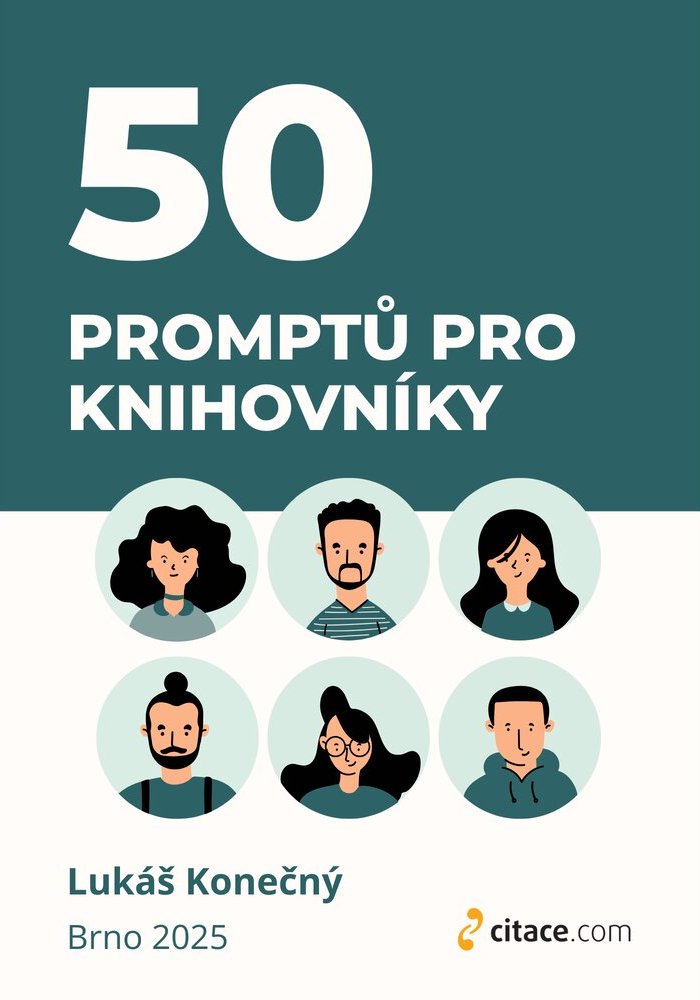
Publikace 50 promptů pro knihovníky představuje praktického průvodce využitím generativní umělé inteligence v knihovnické praxi. Na rozdíl od teoretických příruček přináší konkrétní, ověřené postupy tzv. prompty které pomáhají zefektivnit rešeršní činnost, tvorbu pracovních listů, komunikaci na sociálních sítích i přípravu vzdělávacích aktivit. Autor Lukáš Konečný, odborník na informační vzdělávání a koordinátor vzdělávání společnosti Citace.com, vychází ze své zkušenosti s knihovnickou a lektorskou praxí. Každý prompt je sestaven tak, aby byl ihned použitelný v nástrojích typu ChatGPT nebo Gemini a umožnil knihovníkům rychleji a jistěji pracovat s informacemi. Publikace nabízí přehled možností, jak propojit tradiční knihovnické kompetence s moderními technologiemi, posílit informační gramotnost a ušetřit čas při každodenních úkolech. Je určena všem, kteří chtějí pochopit, jak může AI podpořit kvalitu služeb knihoven i profesní rozvoj jejich pracovníků.